Crucifixion and Courage: Holding Onto Hope in the Darkness
There is a famous Fredrick Buechner quote that seems appropriate for Good Friday: “The worst thing is never the last thing.” Some quote Buechner as prefacing this line with, “The resurrection means that,” and some quote Buechner as ending this sentence with, “There is always hope.” This thought will help us as we read Matthew 27.
Chapter 27 begins with the chief priests and Pharisees handing Jesus over to Pilate, hoping that he would secure his execution and rid them of a problem they could not solve on their own. The religious leaders saw Jesus as a blasphemer and wanted him gone so that they could resume control and power over their Jewish congregation.
Jesus appeared before Pilate several times on Friday. Each time, Pilate had his soldiers inflict more pain, hoping the religious leaders would be satisfied. Pilate lost the battle with the crowd that day and washed his hands of responsibility as he surrendered to the crowd who yelled, “Crucify him!” The chief priests, the Pharisees, and Pilate wanted the crucifixion of Jesus to be the last thing needed to be done with Jesus and to restore order in Jerusalem.
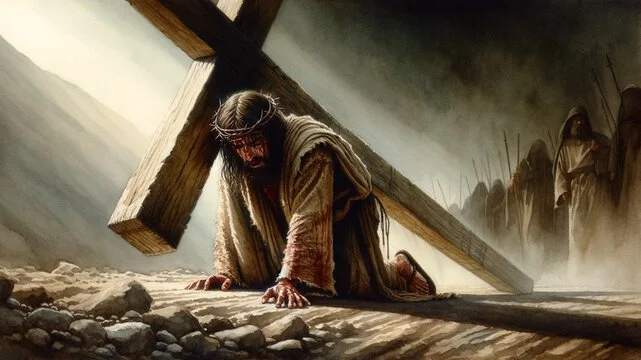
Jesus walked the Via Dolorosa, the sorrowful way, burdened by the cross. Simon of Cyrene gave him temporary relief as he climbed Golgotha’s hill to die for the sins of humanity and to restore all that was broken.
On the cross in agony Jesus cried out to his Father, “Eli, Eli, lema sabachthani?” that is, “My God, my God, why have you forsaken me?”
The words of Buechner call out to us: “The worst thing is not the last thing.”
Listening to a podcast recently I was reminded of Kurt Vonnegut’s book Slaughterhouse-Five. I read it a couple of times; the last time was maybe twenty years ago. The main character, Billy Pilgrim, suffers from post-traumatic stress. The author described Billy as having a framed prayer on his wall. You may have this same prayer somewhere in your keeping as well: “God grant me the serenity to accept the things I cannot change, courage to change the things I can, and wisdom always to tell the difference.” At the end of this moment in the book Vonnegut wrote: “Among the things Billy Pilgrim could not change were the past, the present, and the future.”
What a powerful line for us to remember. But on the cross, Jesus in one moment did in fact change the past, the present, and the future. He did what no man could do for himself. Jesus endured the cross not just to pay for our sins so that we could enjoy eternity with him. He died once and for all time so that all that God had created and declared good at creation could finally be restored. It is the death of Jesus that makes possible that all that is broken in this world might be redeemed for all time.
Father, we struggle to comprehend the suffering that Jesus bore on the cross for us. We bow before you in gratitude not only for the gift of forgiveness that flowed from the cross but also to celebrate that through the sacrifice of Jesus all that is broken is made new. We love you and long to celebrate your resurrection and your return. Come Lord Jesus, Amen.
Your Time with God’s Word
Matthew 27:1-66; Romans 6:10; Hebrews 7:27, 9:26-28; 1 Peter 3:18; 2 Corinthians 5:15 ESV
To receive daily posts delivered directly to your inbox, complete the form at the bottom of our home page.